
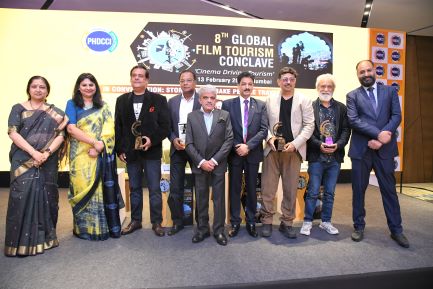
“A location on screen does not remain just geography; it becomes aspiration. It becomes memory. It becomes a dream people wish to experience for themselves,” said Shri Suresh Gopi, Hon’ble Minister of State for Tourism, Government of India, while delivering a special video message during the 8th Global Film Tourism Conclave organized by the PHD Chamber of Commerce and Industry (PHDCCI) on 13 February 2026 in Mumbai.
Calling India ‘a civilization of stories’, he emphasized that from Varanasi’s spiritual aura to the festivals of the Northeast, from Rajasthan’s forts to Kerala’s backwaters, every region carries cinematic depth waiting to be shared with the world. He reaffirmed the Government’s commitment to positioning India as a film-friendly destination through progressive policy reforms and seamless facilitation mechanisms. “When the camera rolls, opportunity must flow to the grassroots,” he noted, highlighting film tourism as a driver of livelihoods, soft power and inclusive growth.
While delivering the Chief Guest address, said Mr. Suman Billa (IAS), Additional Secretary and Director General, Ministry of Tourism, Government of India, stressed that film tourism must be strategically designed rather than left to chance. Citing global research indicating that nearly 80 million travelers are influenced annually by cinema and media, he described film tourism as one of the most cost-efficient and high-impact destination marketing tools available today. “A compelling story unlocks aspiration far more effectively than conventional advertising.”Mr. Billa further said, “Model guidelines, measurable incentive structures linked to screen time, data-driven evaluation, PPP models and immersive film-centric experiences are essential if we are to generate sustained economic value.
With policy clarity, coordination between Centre and States and continuous revenue tracking, cinema can evolve from a cultural asset into a powerful economic engine for India.”The Conclave, themed ‘Cinema Driving Tourism’, was supported by Telangana Tourism and Meghalaya Tourism. It brought together senior policymakers, leading producers, studio heads, content creators, hospitality leaders and tourism stakeholders to deliberate on how India can convert cinematic storytelling into measurable tourism and economic outcomes through structured policy intervention and industry collaboration.
Mr. Jayesh Ranjan (IAS), Special Chief Secretary – Tourism, Government of Telangana, who graced the conclave as the Guest of Honour, outlined the three fundamental requirements for filmmakers: studios, locations and technology. He noted that Telangana, particularly Hyderabad offers an integrated ecosystem that includes advanced equipment and post-production facilities, in some cases surpassing those available in Mumbai. He highlighted that several of the highest-grossing recent films have been non-Hindi productions, with many Tamil films undertaking post-production work in Hyderabad, demonstrating the South’s growing dominance in the production value chain.Speaking about the state’s digital facilitation efforts, he referred to the ‘Film in Telangana’ portal, designed to help filmmakers identify suitable studios, locations and post-production facilities while navigating approvals efficiently. “Filmmakers often struggle with bureaucratic processes. Our portal pre-identifies and streamlines approvals, making filming smoother and faster,” Mr. Ranjan said.
Dr. Ranjeet Mehta, CEO & Secretary General, PHDCCI, described cinema as India’s most underleveraged tourism campaign. Highlighting India’s position as one of the world’s largest film-producing nations, he stressed that each major production creates a ripple effect across hospitality, transport, logistics, design and local employment ecosystems. Drawing parallels with global film tourism success stories such as New Zealand and the United Kingdom, he called for a coordinated national framework, stronger alignment of incentives across states and systematic mapping of tourism footfall linked to major productions.
» Read Complete News.....(You need to login first to read complete news). New User? Register for FREE!
» Back to Travel News